Home | Intervention Overview | Human Security and Equal Dignity
Human Security and Equal Dignity (HSecurityED)
HumanDHS is primarily grounded in academic work. We are independent of any religious or political agenda. However, we wish to bring academic work into "real life." Our research focuses on topics such as dignity (with humiliation as its violation), or, more precisely, on respect for equal dignity for all human beings in the world. This is not only our research topic, but also our core value, in line with Article 1 of the Human Rights Declaration that states that every human being is born with equal dignity (that ought not be humiliated).
We agree with Shibley Telhami, Anwar Sadat Professor for Peace and Development, who advocates the building of bridges from academia as follows, "I have always believed that good scholarship can be relevant and consequential for public policy. It is possible to affect public policy without being an advocate; to be passionate about peace without losing analytical rigor; to be moved by what is just while conceding that no one has a monopoly on justice." We would like to add that we believe that good scholarship can be relevant and consequential not only for public policy, but for raising awareness in general.
We look for interested people, who would like to develop our HSecurityED page. Please see our Call for Creativity. We thank Vegard Jordanger for making us aware of Frederic Laloux's work on Reinventing Organizations (2014).
Our Human Security and Equal Dignity project is part of our quest to build bridges from social science to other areas of life. The notion and concept of security is central to the way governments plan their policies. Traditionally, security is being approached from the angle of military strength or policing capabilities. However, the more the state-of-the-world is characterized by global interconnection, it is not so much military strength that counts anymore, but the willingness to cooperate, not just by states, but also by ordinary people. Thus, the HumanDHS vision of a world of equal dignity for all, away from practices of humiliation, is intimately linked, both locally and globally, with the notion of human security.
We believe that the significant differentiation is not between war versus cowardice, or war versus appeasement. Peace might require even more courage, resolve, and dedication than war. Gandhi disliked the words and ideas of “passive resistance.” The term satyagraha (non-violent action), is a combination of satya (truth-love) and agraha (firmness/force). In the spirit of Mandela and Gandhi, pacifism can therefore not mean the rejection of force. United Nations peace keeping missions, for example, need a stronger mandate than hitherto if they are to be enabled to prevent and police regional and local conflicts – and a strong mandate means the interlink of coercion with respect. Respectful firmness is the way to stop those who are in the business of turning spirals of humiliation into an abyss that can swallow all. The genocide in Rwanda, for example, could have been avoided, not by smiling at the perpetrators, but by firm action to stop the killers.
Social control and policing combine firmness with respect. And social control and policing are the suitable concepts to apply in an interconnected "global village," not outdated concepts that were adapted to a compartmentalized world, such as war against "ememies." The concept of war is outdated in a globalizing world. The global village needs internal social control and policing of its inner affairs.
In an interdependent world, keeping "enemies out" to attain security is no longer effective. Keeping the world united is the only way to peace. And in order to achieve the necessary global social cohesion, old cultural wisdom can be used, see the example from Egypt further down.
Twenty-to-two, women and men! Coercion and respect can be combined
(Making Enemies: Humiliation and International Conflict, pp. 154-157)
... I was amazed at the low rate of crime and unrest in Cairo, a metropolis of approximately 10 to 15 million people. A high degree of social control is part of Egyptian culture. I frequently witnessed incidents such as the following situation, which gave testimony to this social control:
An accident occurs in the street in the middle of overcrowded Cairo. The two drivers get out of their cars and angrily survey the damage. They shout and jump at each others necks. They scream, they shove and hit one another.
Around this scene, in the street, in coffee houses, in shops, people watch attentively, their faces reflecting seriousness, urgency, respect and involvement. About ten to twenty men, usually young and strong, slowly approach the two men. They stand in two groups of five to ten men each, with each group assuming responsibility for one of the opponents, restraining and talking to him. The restraint used is enough so that neither opponent can hit or hurt the other, but both can still shout and scream and make brief attacking lunges.
Each group speaks with the man to which it has assigned itself, talking calmly and with respect. They show him that they understand the urgency which forces a man to behave in such a dramatic manner (a person who is outside him/herself is almost holy in Egypt ). The "facilitators" try to understand the nature of the conflict and propose various compromises to resolve it. They do not focus unduly on the rational side of the conflict, they rather constantly grant respect to the fact that the opponents are psychologically overburdened and that the rupture of social peace has to be healed.
After ten or fifteen minutes the opponents begin to calm down. If it's appropriate, they agree on a compromise. If necessary, some facilitators promise to act as witnesses and/or enforcers of the compromises. The conflict is over. The opponents leave. The facilitators go back to their previous occupations without a lot of fanfare. Patching up conflicts is routine.
The conflict resolution and containment street scenes that I witnessed usually included a ratio of 20 to 2 ratio, or at least 10 to 2. 20 physically powerful men were required to cool and pacify two clashing opponents. If this scenario is a blueprint for conflict resolution, resources for the prevention, containment, and resolution of conflicts around the world need to be increased. Overpowering numbers of blue helmets/global police persons with a credible overpowering mandate and well-devised overpowering strategies are required. The Powell and Rumsfeld approaches need to be intelligently combined with each other, and embedded into respect for opponents as underlying orientation.
In many regions - the so-called failing states - the absence of good police forces must be remedied. In other regions it is the highjacking of police forces by elite interests that has to be addressed. Resources invested in prevention and containment are well spent; they prevent the much higher investments that are necessary post-mayhem.
The international community can develop a wealth of creative ideas based on the 20 to 2 ratio blueprint. Why is it that hundreds of thousands of soldiers are available, but not hundreds of thousands of inspectors? Or, what about human shields preventing atrocities? In the final part of his book Getting to Peace, William Ury (1999) suggests ten roles for Homo negotiator: the provider, the teacher, the bridge builder, the mediator, the arbiter, the equalizer, the healer, the witness, the referee, and the peace -keeper.
It is interesting to observe how the Egyptian approach combines elements of coercion and respect from traditionally male and female roles. The scene combines "female" talking, understanding, empathizing, perspective-taking, and healing on one side, and a "male" potential for overpowering, coercion, force, violence, and aggression on the other. "Male" strength and moderated counter-aggression restrain the fighters. "Female" awareness of the cohesion of the social fabric creates an atmosphere in which the fighters feel they are being taken seriously. To combine the "male" aspect of force with "female" empathy could be the modern recipe of conflict resolution. The old "male" strategy of using destructive force is not appropriate in an interdependent modern global village, but the "male" ability to use restraining force continues to be an important tool.
Today's men and women are invited to share roles - men to use more of the traditional "female" role characteristics and women to become more "visible." Formerly, visibility was connected to the man guarding the frontiers separating inside from outside, just as clothes protect and hide the inside from outside viewers. There is an Egyptian saying, "The woman is the neck and the man the head; the woman turns the neck wherever she wants." In other words, Egyptian women feel that they create relevant content inside the home, which is presented to the outside by their men. With the disappearance of an outside sphere in a global village, this "division of labor" loses its significance, letting women and men alike dwell together inside, in intimate privacy, and appear visibly outside.
UNESCO's Culture of Peace Programme urges the strengthening of the "female" aspect in conflict resolution efforts. The list of potential female contributions is a long one (adapted from Lindner, 1999 ): using multitrack, "track II," and citizen-based diplomacy; installing early warning institutions; rethinking the notion of state sovereignty; setting up projects to study and understand the history of potential conflict areas, collecting this information, and making it available to decision makers; using psychology on a macro level, taking identity as a bridge; keeping communication going between warring parties; talking behind the scenes; including people besides the warlords in peace negotiations; developing conflict-resolution teams with less hierarchy and more creativity; setting up mediation teams; installing "truth commissions"; allowing warring parties to feel the world community's care, respect, and concern; taking opponents in a conflict out of their usual environment; taking the adversaries' personal feelings and emotions seriously; recognizing the importance of human dignity; introducing sustainable long-term approaches on the social and ecological level; progressing from spending aid money after a disaster to allocating resources to prevent it; and so on.
According to the Culture of Peace Programme and conflict resolution experts around the world, these "female" efforts must be combined with a certain amount of "male" coercion to achieve peace. The term social control expresses the combination of both aspects. On the national level, police and prisons represent some of the coercive aspects (incidentally more effective if the average citizen does not carry weapons), while institutions like lawyers, courts, and rehabilitation programs have the potential to fulfill the role of social caring and healing. Such a culture of peace, merging formerly separate "male" and "female" role descriptions, contains cycles of humiliation among conflict parties without humiliating them.
If we desire world peace, we need to build global awareness and global institutions that are strong enough for the task of social control. On April 17, 2003, Kofi Annan explained that he rejects the idea of the UN taking on a task it cannot fulfill. Annan wants resources and a strong mandate to avoid a UN failure caused by member states withholding support. He says, in short, that you should not send out a boy with a stick to kill a lion, then lament the boy's ineptitude.
Some Basic Principles for an Enabling Future
The Earth Charter's principles
I. RESPECT AND CARE FOR THE COMMUNITY OF LIFE
1. Respect Earth and life in all its diversity.
a. Recognize that all beings are interdependent and every form of life has value regardless of its worth to human beings.
b. Affirm faith in the inherent dignity of all human beings and in the intellectual, artistic, ethical, and spiritual potential of humanity.
2. Care for the community of life with understanding, compassion, and love.
a. Accept that with the right to own, manage, and use natural resources comes the duty to prevent environmental harm and to protect the rights of people.
b. Affirm that with increased freedom, knowledge, and power comes increased responsibility to promote the common good.
3. Build democratic societies that are just, participatory, sustainable, and peaceful.
a. Ensure that communities at all levels guarantee human rights and fundamental freedoms and provide everyone an opportunity to realize his or her full potential.
b. Promote social and economic justice, enabling all to achieve a secure and meaningful livelihood that is ecologically responsible.
4. Secure Earth's bounty and beauty for present and future generations.
a. Recognize that the freedom of action of each generation is qualified by the needs of future generations.
b. Transmit to future generations values, traditions, and institutions that support the long-term flourishing of Earth's human and ecological communities.
In order to fulfill these four broad commitments, it is necessary to:
II. ECOLOGICAL INTEGRITY
III. SOCIAL AND ECONOMIC JUSTICE
IV. DEMOCRACY, NONVIOLENCE, AND PEACE
"Road Map To Good Governance - The Nine 'I' Model" by Syed Ahsanul Alam
Syed Ahsanul Alam, in his article "Road Map To Good Governance - The Nine 'I' Model" explains that "Democracy cannot flourish in the absence of good governance."
He explains: "The pre-condition for good governance is effective democratic institutions for democratizing the society. Improvement of the living standard of people cannot happen where people cannot participate in governance, human rights are not respected, information does not flow, and civil society and the judiciary are weak. Nine criteria of good governance may be used to determine whether any country qualifies to have good governance are:
1. INDEPENDENT AND NON PARTISAN ELECTION COMMISSION
2. INDEPENDENT JUDICIARY AND THE RULE OF LAW
3. INDEPENDENT MEDIA AND FREEDOM OF SPEECH
4. INDEPENDENT ANTI-CORRUPTION COMMISSION
5. INVESTING IN THE PEOPLE
6. INDEPENDENT AND EFFECTIVE PARLIAMENT
7. INDEPENDENT HUMAN RIGHTS COMMISSION
8. INDEPENDENT OMBUDSMAN SYSTEM
9. INVESTMENT FRIENDLY GOVERNMENT."
"Road Map To Good Governance - The Nine 'I' Model" ( www.goodgovernancebd.org). Syed Ahsanul Alam is Associate Professor of marketing at the Univ. of Chittagong, & Chairman - Center for Good Governance.
Eight Principles by David Held
David Held, Graham Wallas Chair in Political Science, London School of Economics and Political Science, United Kingdom, sets out a number of principles which he believes can be universally shared, and can form the basis for the protection and nurturing of each person’s equal significance in the moral realm of humanity. Eight principles are paramount. They are the principles of:
1. equal worth and dignity;
2. active agency;
3. personal responsibility and accountability;
4. consent;
5. collective decision making about public matters through voting procedures;
6. inclusiveness and subsidiarity;
7. avoidance of serious harm; and
8. sustainability.
Held, D. (2004a) Global Covenant: The Social Democratic Alternative to the Washington
Consensus. Cambridge: Polity Press.
Held, D. (2004b) ‘Future Globalizations’, a plenary talk given at the Inaugural Conference of
Globalization Studies Network, The University of Warwick, Coventry, UK, 20 August 2004.
Held, D. (2005) ‘Principles of Cosmopolitan Order’, in G. Brock and H. Brighouse (eds): The
Political Philosophy of Cosmopolitanism. Cambridge: Cambridge University Press.
Creating an Inclusive Society: Practical Strategies to Promote Social Integration
Summary of E-dialogue, 23 May – 20 June 2007, organized by the Division for Social Policy and Development (DSPD) of the United Nations Department of Economic and Social Affairs (UNDESA), in collaboration with UNESCO and UN-HABITAT.
Please read more at http://www.un.org/esa/socdev.
Synthesis of the views expressed by participants:
• Critical Elements Necessary for Creating an Inclusive Society
• Rule of Law
• Judiciary
• Education
• Shared Common Goal /Vision
• Cultural Pluralism/Respect for diversity
• Strong Civil Society ( civil rights , civic responsibility, civic engagement, citizenship and mutual trust)
• Equal Opportunities for Active Participation
• Equitable Distribution of Economic and Social Resources
• Inclusive Policies and Institutions
• Good Governance and Representative Leadership
• Equal access to Pubic Information, Public Infrastructures and Facilities
• Effective Urban Management
Principles for Global Sustainability
David Krieger is President of the Nuclear Age Peace Foundation and a Councilor on the World Future Council
• Responsibility to allocate resources so that greed for the few does not eclipse need for the many. (Survival Principle; Democracy Principle)
• Responsibility to preserve the planet and its resources for future generations. (Intergenerational Equity Principle)
• Responsibility to do no irreparable harm to the planet and its inhabitants. (Precautionary Principle)
• Responsibility to foster diversity of species and ideas. (Anti-Monopoly Principle)
• Responsibility to make war a last resort, not a first resort of the powerful. (Nonviolence Priority Principle)
• Responsibility to hold accountable the perpetrators of war crimes, crimes against peace, and crimes against humanity, including genocide. (Nuremberg Principles; International Criminal Court)
• Responsibility to guarantee basic human rights for all individuals. (Human Rights Principle: Universal Universal Declaration of Human Rights, Torture Convention, etc.)
• Responsibility to cooperate across national borders to achieve these ends. (State Cooperation Principle: Global problems are incapable of solution by single states, no matter how powerful.)
• Responsibility to choose hope over despair. (Hope Principle; Perseverance Principle)
• Responsibility to leave the planet a better place than you found it. (Individual Action Principle; Horace Mann Principle: “Be ashamed to die until you have won some victory for humanity.”)
• Responsibility to educate for global sustainability. (Education Principle; Critical Thinking Principle)
In sum, I would encourage you to seek to advance global sustainability by adopting a planetary perspective, doing no harm, engaging in doing good for the planet and its present and future inhabitants, choosing hope, and persisting. If we accept these responsibilities as individuals and work to implement them in our national and international policies, we can turn Earth Day into a year-around commitment to creating a planet we can be proud to pass on to future generations.
Ten Commandments
Evo Morales appearances at American University and the OAS.
See 10 commandments.
Worldchanging
Worldchanging is a 501(c)3 media organization that comprises a global network of independent journalists, designers and thinkers covering the world's most intelligent solutions to today's problems. We inspire readers around the world with stories of the most important and innovative new tools, models and ideas for building a bright green future. Our readers are ready to change the world, and Worldchanging links them to the first steps.
Links
Please note that the entire HumanDHS website is maintained by volunteers, since its inception in 2003, and this is mainly done by Evelin Lindner. Until 2012, she usually pasted interesting news into this Links section. From July 2012 until 2017, she tagged interesting information on delicious.com. From 2017 onward, you see Evelin's personal list of interesting web links on Twitter: Follow @evelinlindner
An Interview With Dr. Nora Sveaass: Why Torture is Wrong
by Nilantha Ilangamuwa
... A state that allows torture to happen not only violates international human law but creates a room that is extremely destructive. It undermines the trust and confidence that every society must contain, and such practices open up for more violence and disrespect of human rights. What was attempted as part of the war against terror was to create the picture that better one guilty than many innocent. But there is absolutely no justification for torture. And this campaign has also been used as a way of getting rid of or pacifying opposition. A lot of human rights violations over the last years have taken place under the auspices of fighting terror. The campaigns to fight this are extremely important. In addition, it has been argued, especially from people trained in interrogation and forensic psychology that torture, in addition to be totally wrong, also brings about wrong or false intelligence...
Read more at http://www.counterpunch.org/2013/10/11/why-torture-is-wrong/.
The System Improvement Process
SIP was developed to solve any difficult large-scale social problem. This includes the "excessive humiliation problem." Systems Engineer Jack Harich invites all researchers to study SIP (in a personal message, 15th January 2013).
Monitoring Economic Performance, Quality of Life and Sustainability
December 2010 Joint Report as Requested by the Franco-German Ministerial Council http://www.sachverstaendigenrat-wirtschaft.de/fileadmin/dateiablage/Expertisen/2010/ex10_en.pdf.
Age of Cyber Warfare Is 'Dawning'
Cyber war has moved from fiction to fact, says a report. Compiled by security firm McAfee, it bases its conclusion on analysis of recent net-based attacks. Analysis of the motives of the actors behind many attacks carried out via the internet showed that many were mounted with a explicitly political aim...
See more at http://news.bbc.co.uk/go/pr/fr/-/2/hi/technology/8363175.stm and http://newsroom.mcafee.com/article_print.cfm?article_id=3594.
Japan 'Sought US Nuclear Help'
In 1965 Japan asked the US to be ready to launch a nuclear attack on China if war broke out between the Asian rivals, documents from the time indicate...
Please read more at http://news.bbc.co.uk/go/pr/fr/-/2/hi/asia-pacific/7795246.stm.
Billions 'Wasted' by Aid System
Billions of dollars will be wasted unless there is a radical overhaul of the system of giving aid, a report from a leading aid agency warns. Care International says too much money is being spent on short-term fixes during emergencies, rather than on longer-term prevention work. The number of people living "on the edge of emergency" has nearly doubled to 220 million in two years, Care says. The report comes ahead of a high-level UN meeting on poverty goals next week. Halving poverty and hunger around the world by 2015 are key objectives of the UN's Millennium Development Goals (MDG)...
Please read more at http://news.bbc.co.uk/go/pr/fr/-/2/hi/in_depth/7622275.stm, and download the report from http://www.careinternational.org.uk/?lid=11686.
World Trade Talks End in Collapse
Marathon talks in Geneva aimed at liberalising global trade have collapsed, the head of the World Trade Organisation has said. Pascal Lamy confirmed the failure, which officials have blamed on China, India and the US failing to agree on import rules. EU Trade Commissioner Peter Mandelson said the result was "heartbreaking". The talks were launched in 2001 in Doha and were seen as providing a cornerstone for future global trade. The main stumbling block was farm import rules, which allow countries to protect poor farmers by imposing a tariff on certain goods in the event of a drop in prices or a surge in imports. India, China and the US could not agree on the tariff threshold for such an event...
Please read more at http://news.bbc.co.uk/go/pr/fr/-/1/hi/business/7531099.stm.
Terror Focus 'Hits Security Work'
Work of the UK's intelligence services is suffering because of the focus on counter-terrorism, a report has said.
Parliament's Intelligence and Security Committee (ISC) said that extra funding for the services may be needed.
The head of MI6, John Scarlett, told the committee that counter-terrorism accounted for more than half of his security service's workload.
The government said the scale of the terrorist threat meant some of the work had been "reduced but not overlooked"...
Please read more at http://news.bbc.co.uk/go/pr/fr/-/1/hi/uk_politics/7215925.stm.
The Earth Federation Movement
The Earth Federation Movement includes a worldwide association of World Constitution and Parliament Association (WCPA) Chapters and affiliated independent organizations, such as many youth, environmental, and human rights organizations, that affirm the creation of a non-military, democratic Earth Federation under the Constitution for the Federation of Earth. We have several web sites associated with our work for global peace with justice, environmental sustainability, and prosperity such as www.earthfederation.info.
Dr. Glen T. Martin is the Secretary-General of WCPA and President of the Institute on World Problems. Since its founding in 1958, the WCPA has focused on creating a non-military, democratic Constitution for the Federation of Earth. It has done this through four Constituent Assemblies of World Citizens meeting from 1968 to 1991, when the Constitution was finally completed in its present form.
WCPA now works to get the nations and people of the world to ratify the Constitution through the criteria specified in Article 17. The Constitution is permeated by the concept of human dignity, focused especially in Articles 12 and 13 on human rights. WCPA sees the ratification of the Earth Constitution as a central structural change, creating global democratic institutions of unity in diversity, that can facilitate the deep spiritual change toward planetary maturity that is also necessary for a world of peace, with justice and sustainability.
Joseph P. Baratta
Joseph P. Baratta (2004)
The Politics of World Federation
Vol.1: The United Nations, U.N. Reform, Atomic Control.
Vol. 2: From World Federalism to Global Governance
Westport, CT: Praeger
Please see here the Introduction to both volumes.
Please see here an editorial on the work of Joseph Baratta and Virginia Swain.
Garry Davis: World Citizenship, World Passport, World Presidency, World Service Authority, World Government of World Citizens, World Government House
Wikipedia: Sol Gareth "Garry" Davis (July 27, 1921 – July 24, 2013) was an international peace activist who created the World Passport, a fantasy travel document based on his interpretation of Article 13(2), Universal Declaration of Human Rights and on the concept of world citizenship. Previously Davis had worked as a Broadway stage actor and served as an American bomber pilot in World War II. He was a devoted World Federalist, although a consistent critic of the World Federalist Movement (quoted from Wikipedia).
Our dear Garry Davis went into hospice care on 18 July 2013, and died six days later. We mourn him in deep admiration for his life work and resonate with every word in Rene Wadlow's lovely reflection on Garry Davis: « And Now the People Have The Floor »
See also:
• Garry Davis’s Speechat the 2007 Workshop on Transforming Humiliation and Violent Conflict at Columbia University in New York
• Garry Davis at the 2009 Dignity Conference in Honolulu, Hawai'i
• World Citizen Radio with Garry Davis interviewing Evelin Lindner,
Global Radio Alliance, Sunday, November 11, 2012
• Garry Davis and Mariana Vergara in Dialogue on the World Passport at the 2012 Workshop on Transforming Humiliaton and Violent Conflict at Columbia University in New York:
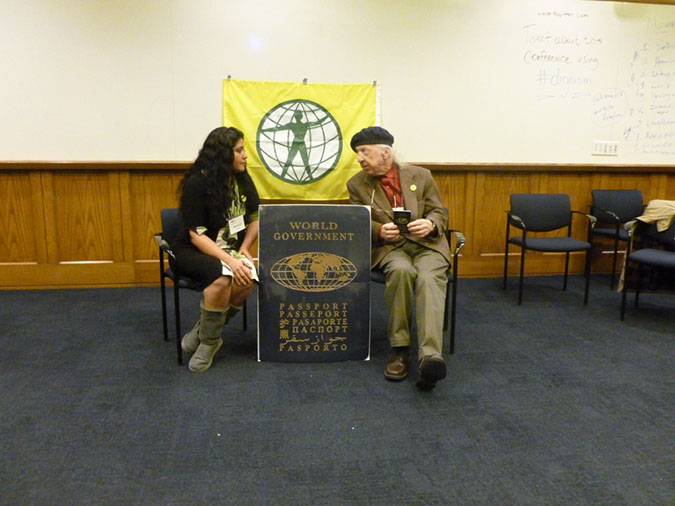
Please click on the picture above or here to see all the 177 photos of Day One of the 2012 Workshop
• Please see also The World Is My Country, and the documentary on Garry Davis by Arthur Kanegis:
Rosika Schwimmer and World Government
Rosika Schwimmer or Bédy-Schwimmer "Rózsa" Rózsika (1877-1948) set out to create a world government. In 1935 she formed the World Centre for Women's Archives with Mary Ritter Beard. She received a World Peace Prize in 1937 and formed the Campaign for World Government with Lola Maverick Lloyd. In 1947 she was nominated for Nobel Peace Prize but no one received it the next year...
Please read more on http://en.wikipedia.org/wiki/Rosika_Schwimmer, or, please read also Remarks on the History of Hungarian Feminism by Judit Acsády.
Creating an Inclusive Society: Practical Strategies to Promote Social Integration
Summary of E-dialogue, 23 May – 20 June 2007, organized by the Division for Social Policy and Development (DSPD) of the United Nations Department of Economic and Social Affairs (UNDESA), in collaboration with UNESCO and UN-HABITAT.
Please read more at http://www.un.org/esa/socdev.
Münchner Sicherheitskonferenz/Munich Conference on Security - the "Davos" of Security Policy
Welcome words from organisator Horst Teltschik: "The Munich Conference on Security Policy can look back on a tradition of almost four decades. The international security community - ministers, representatives of the armed forces, members of parliament, journalists and experts, now from more than 40 countries - has met in Munich since the beginning of the 1960s. Each year, some 250 participants discuss in depth their views on the development of transatlantic relations as well as European and global security..."
Please
read more at http://www.securityconference.de/grusswort/index.php?sprache=en&.
Richest 2% Own 'Half the Wealth'
By Andrew Walker
Economics correspondent, BBC World Service
The richest 2% of adults in the world own more than half of all household wealth, according to a new study by a United Nations research institute. The report, from the World Institute for Development Economics Research at the UN University, says that the poorer half of the world's population own barely 1% of global wealth. There have of course been many studies of worldwide inequality. But what is new about this report, the authors say, is its coverage.
It deals with all countries in the world - either actual data or estimates based on statistical analysis - and it deals with wealth, where most previous research has looked at income.
What they mean by wealth in this study is what people own, less what they owe - their debts. The assets include land, buildings, animals and financial assets.
Please read the entire article at http://news.bbc.co.uk/go/pr/fr/-/1/hi/business/6211250.stm.
Global Responses to Global Threats
Contemporary threats are often interconnected. Led, in large part, by the United Nations, there is growing international awareness that problems such as international terrorism or armed conflict cannot be dealt with in isolation from those of extreme poverty or environmental degradation. These are all global issues, which threaten human security as well as state security, and they recognise no national borders.
9/11 demonstrated in the most dramatic way that rich Western countries cannot insulate themselves from developments taking place elsewhere. Poverty is not just a development issue; HIV/AIDS is not just a disease; climate change does not just affect poor countries; terrorism does not just happen in failed states - these have security implications for every country. The different societies that make up humanity are interconnected and interdependent today as never before. Only by working together will countries be able to overcome the threats they face.
Oxford Research Group has recently completed a long-term research project examining these issues. The resulting report, Global Responses to Global Threats: Sustainable Security for the 21st Century, was published in June 2006. It offers an overview of four groups of factors that we conclude should be considered the root causes of conflict and insecurity in today's world and the likely determinants of future conflict:
• climate change;
• competition over resources;
• marginalisation of the majority world; and
• global militarisation.
Please read the entire text at http://www.oxfordresearchgroup.org.uk/programmes/globalsecurity/globalthreats.htm.
Dialogue on "Peace, Human Tights, Human Security and Disarmament"
The dialogue on "Peace, Human Tights, Human Security and Disarmament" was part of the "International Conference for the Reform of International Institutions: Dialogues between different levels of governance and civil society actors," 20-21 November in Geneva.
Speakers were invited to answer those questions: "How, what, when and by whom should world disarmament policies be restored and the arms trade ended? How can we effectively reaffirm our commitment to actively protect and promote all human rights, the rule of law and democracy (World Summit 2005)? How and what truly operational reforms and measures should we introduce in the Security Council, the recently-established Human Rights Council and the General Assembly itself in order to achieve these goals?"
US Is Top Purveyor on Weapons Sales List
Shipments grow to unstable areas
Boston Globe, by Bryan Bender, Globe Staff, November 13, 2006.
WASHINGTON -- The United States last year provided nearly half of the weapons sold to militaries in the developing
world, as major arms sales to the most unstable regions -- many already engaged in conflict -- grew to the highest
level in eight years, new US government figures show.
According to the annual assessment, the United States supplied $8.1 billion worth of weapons to developing countries
in 2005 -- 45.8 percent of the total and far more than second-ranked Russia with 15 percent and Britain with a little
more than 13 percent.
Arms control specialists said the figures underscore how the largely unchecked arms trade to the developing world has
become a major staple of the American weapons industry, even though introducing many of the weapons risks fueling
conflicts rather than aiding long-term US interests.
The report was compiled by the nonpartisan Congressional Research Service.
Please read the entire article at www.boston.com.
International Court in First Case
The only permanent international war crimes court has opened its first hearing, in the case of a Democratic Republic of Congo militia leader.
Judges at the International Criminal Court (ICC) are to decide whether Thomas Lubanga should stand trial for allegedly recruiting child soldiers.
The five-year DR Congo conflict led to an estimated four million deaths.
The US strongly opposed the creation of the ICC, fearing the political prosecution of its soldiers.
Please read the entire article at http://news.bbc.co.uk/go/pr/fr/-/2/hi/europe/6131198.stm.
Mubarak Warns on Saddam Execution
Egyptian President Hosni Mubarak has warned that hanging former Iraqi leader Saddam Hussein will lead to even more bloodshed in Iraq.
A Baghdad court condemned Saddam Hussein to death on Sunday for the killing of 148 Shia Muslims after a 1982 assassination attempt against him.
Mr Mubarak said hanging the former president would only exacerbate ethnic and sectarian divisions between Iraqis.
They are the first public comments on the sentence by an Arab leader.
"Carrying out this verdict will explode violence like waterfalls in Iraq," Mr Mubarak is quoted as saying by Egyptian state-run newspapers.
The verdict "will transform (Iraq) into pools of blood and lead to a deepening of the sectarian and ethnic conflicts," he said.
Read the entire article at http://news.bbc.co.uk/go/pr/fr/-/2/hi/middle_east/6134626.stm.
MI5 Tracking '30 UK Terror Plots'
MI5 knows of 30 terror plots threatening the UK and is keeping 1,600 individuals under surveillance, the security service's head has said.
Dame Eliza Manningham-Buller warned the threat was "serious" and "growing".
She said future attacks could be chemical or nuclear and that many of the plots were linked to al-Qaeda.
Prime Minister Tony Blair said the terrorist threat was "very real" and spoke of "poisonous propaganda" warping the minds of young people.
Please read the entire article at http://news.bbc.co.uk/go/pr/fr/-/1/hi/uk/6134516.stm.
Lottery Plan for Bosnian Weapons
By Nicholas Walton
BBC News, Sarajevo
A new month-long initiative to encourage Bosnians to hand in illegal weapons comes in to force on Sunday.
Those handing over their small arms will be entered into a lottery, with prizes including motor scooters and kitchen appliances...
Please read the entire article at http://news.bbc.co.uk/go/pr/fr/-/1/hi/world/europe/6117750.stm.
Human Security
The Commission on Human Security was established in 2001 and is co-chaired by Sadako Ogata and Amartya Sen. It aims at developing the concept of human security and proposing a concrete program of action for the international community. The Concept of Human Security is explained as follows: "In parallel with rapid globalization, trans-national issues such as infectious diseases and environmental problems have spread all over the world and frequent regional conflicts and economic factors have given rise to a serious issue of involuntary movement of people such as refugees and internally displaced persons (IDPs).
It is therefore necessary, in addition to the concept of traditional national security, to strengthen a framework in order to protect and empower individuals and their communities and to protect the potential of each individual, focusing on viewpoints of individuals, to overcome serious and wide-ranged direct threats to human lives, livelihoods and dignity.
Geneva Call
Geneva Call is an international humanitarian organisation dedicated to engaging armed non-state actors (NSAs) to respect and to adhere to humanitarian norms, starting with the ban on anti-personnel (AP) mines. Geneva Call is committed to the universal application of the principles of international humanitarian law and conducts its activities based on the principles of neutrality, impartiality and independence. of neutrality, impartiality and independence.
A World War II Poster 
A World War II poster shows a fist with knightly armament and accompanies this with the following text: Das ist der Weg zum Frieden - die Feinde wollen es so! darum zeichne Kriegsanleihe!
Translation: This [the fist] is the path to peace - the enemies will it so! therefore sign up for war bonds!
(This poster is displayed in the Center for International Conflict Resolution (CICR), Columbia University, 420 West 118th Street, New York, NY 10027.)
HumanDHS comment: In a globalizing interdependent world, which faces numerous global challenges, this world has to be kept together, not to be kept fragmented. "Enemies," and those who blindly accept the "will of the enemy" as definitorial for their world, have not yet understood this. Instead of being given the right to dicate the world's agenda, "enemies" need to be invited in, invited to become neighbors and partners, together helping to secure the survival of the human family. An interdependent world can no longer afford allowing "enemies" to highjack the agenda. Instead of being given definitorial power, "enemies" need to be turned into partners, or, if this is not possible, at least marginalized; in any case, they need to be disallowed to define the world's schedule. As part of this effort, humankind has to stop rulers who "use" enemies to stay in power.
A World War II Poster 
Join the Royal Air Force and Share their Honour & Glory
(This poster is displayed in the Center for International Conflict Resolution (CICR), Columbia University, 420 West 118th Street, New York, NY 10027.)
HumanDHS comment: In a globalizing interdependent world, it is no longer a necessary strategy to die so as to keep "enemies out." It is no longer in tune with the new reality to promote untimely death as honorable and glorious.
Combatants for Peace
We are a group of Israeli and Palestinian individuals who were actively involved in the cycle of violence in our area. The Israelis served as combat soldiers in the Israel Defense Forces and the Palestinians were involved in acts of violence in the name of Palestinian liberation.
We all used weapons against one another, and looked at each other only through weapon sights; however today we cooperate and commit ourselves to the following:
• We no longer believe that the conflict can be resolved through violence.
• We believe that the blood shed will not end unless we act together to terminate the occupation and stop all forms of violence.
• We call for the establishment of a Palestinian State, alongside the State of Israel. The two states can exist in peace and security beside each other.
• We will use only non-violent means to achieve our goals and call for both societies to end violence.
Global Alliance for Ministries and Departments of Peace
Under the name of the People's Initiative for Departments of Peace, the Global Alliance for Ministries and Departments of Peace was launched at the first People's Summit for Departments of Peace, held in London October 18-19, 2005, with the intention of supporting national-level campaigns to establish departments of peace in governments throughout the world. The following articles provide background information on the Global Alliance for Ministries and Departments of Peace.
The Pixel Press
At PixelPress our intent is to encourage documentary photographers, writers, filmmakers, artists, human rights workers and students to explore the world in ways that take advantage of the new possibilities provided by digital media. We seek a new paradigm of journalism, one that encourages an active dialogue between the author and reader and, also, the subject. Our online magazine features projects that use a variety of linear and non-linear strategies, attempting to articulate visions of human possibility even while confirming human frailty. For us the digital revolution is a revolution in consciousness, not in commerce. We work with organizations such as Crimes of War, Human Rights Watch, World Health Organization and UNICEF to create Web sites that deal directly with contemporary issues in complex and innovative ways that circumvent media sensationalism and simplification. We also try to factor in ways that the viewer can help remedy social problems, rather than remain a spectator. Recently we completed a site focusing on how to end polio worldwide; another trying to aid an orphanage in Rwanda; one trying to reclaim the Brazilian forest; and a site featuring the images of photographers from the Vietnam War. And we also create books with photographers such as Machiel Botman, Kent Klich and Sebastião Salgado on social themes, as well as traveling exhibitions using both digital and conventional processes.


 2003 – present, Human Dignity and Humiliation Studies