Home | Intervention Overview | United Nations for Equal Dignity
United Nations for Equal Dignity
HumanDHS is primarily grounded in academic work. We are independent of any religious or political agenda. However, we wish to bring academic work into "real life." Our research focuses on topics such as dignity (with humiliation as its violation), or, more precisely, on respect for equal dignity for all human beings in the world. This is not only our research topic, but also our core value, in line with Article 1 of the Human Rights Declaration that states that every human being is born with equal dignity (that ought not be humiliated).
We agree with Shibley Telhami, Anwar Sadat Professor for Peace and Development, who advocates the building of bridges from academia as follows, "I have always believed that good scholarship can be relevant and consequential for public policy. It is possible to affect public policy without being an advocate; to be passionate about peace without losing analytical rigor; to be moved by what is just while conceding that no one has a monopoly on justice." We would like to add that we believe that good scholarship can be relevant and consequential not only for public policy, but for raising awareness in general.
We look for interested people, who would like to develop our UNED page. Please see our Call for Creativity.
Our aim is to invite UN critics into the notion that we have but One Planet and that we inhabit it together. We promote the concept of joint responsibility, away from deepening divides that might cost humankind's survival in times when only global cooperation can address the global problems that we have. We believe that investing time and energy in mutual finger pointing at past failures is not constructive (in no situation in life). Fingerpointing is especially destructive when it deepens rifts in times when all of humankind need's to buy into the idea of global joint responsibility.
The fact that we, as humankind, do not yet have a good "police" in the global village and that global laws are wanting, does not mean that we should not work for them, jointly, all together. What is insufficient ought to be made sufficient, jointly, rather than being decried in ways that increase division.
Meanwhile, we have no choice but to cope with incomplete and weak global institutions at our best ability, however, we need to be clear that this is our joint responsibility.
In other words, our aim is to invite UN critics into the notion that we have but One Planet and that we inhabit it together. We would like to invite critics into the concept of joint responsibility, away from deepening divides that might cost us our survival in times when only global cooperation can address the global problems that we have.
Global interdependence forces us to see problem zones and conflict areas, both ecological and social, as a responsibility of the entire international community. The consequences of global interdependence will punish us all, if we try to preserve a conceptualization of the world as entailing independent entities that can survive as isolated "islands." (The conceptualization of the world as containing "islands" or "isolated villages" indeed had some validity, yet only prior to the emergence of one single global "village.")
Please see here the Friends of the U.N., a non-governmental organization associated with the United Nations Department of Public Information. It is a nonprofit, tax-exempt (501 C-3) organization.
Friends of the U.N. is an affiliate of the UNA-USA Council of Organizations.
Links
Please note that the entire HumanDHS website is maintained by volunteers, since its inception in 2003, and this is mainly done by Evelin Lindner. Until 2012, she usually pasted interesting news into this Links section. From July 2012 until 2017, she tagged interesting information on delicious.com. From 2017 onward, you see Evelin's personal list of interesting web links on Twitter: Follow @evelinlindner
The System Improvement Process
SIP was developed to solve any difficult large-scale social problem. This includes the "excessive humiliation problem." Systems Engineer Jack Harich invites all researchers to study SIP (in a personal message, 15th January 2013).
African Free Trade Zone Is Agreed
The leaders of three African trading blocs on Wednesday agreed to create a free trade zone of 26 countries with a GDP of an estimated $624bn (£382.9bn).
It is hoped the deal will ease access to markets within the region and end problems arising from the fact several countries belong to multiple groups. The deal also aims to strengthen the bloc's bargaining power when negotiating international deals. Analysts say the agreement will help intra-regional trade and boost growth. The three blocs which struck the deal were the Southern African Development Community (SADC), the East African Community (EAC) and the the Common Market for Eastern and Southern Africa (Comesa)...
Please read more at http://news.bbc.co.uk/go/pr/fr/-/2/hi/business/7684903.stm.
Billions 'Wasted' by Aid System
Billions of dollars will be wasted unless there is a radical overhaul of the system of giving aid, a report from a leading aid agency warns. Care International says too much money is being spent on short-term fixes during emergencies, rather than on longer-term prevention work. The number of people living "on the edge of emergency" has nearly doubled to 220 million in two years, Care says. The report comes ahead of a high-level UN meeting on poverty goals next week. Halving poverty and hunger around the world by 2015 are key objectives of the UN's Millennium Development Goals (MDG)...
Please read more at http://news.bbc.co.uk/go/pr/fr/-/2/hi/in_depth/7622275.stm, and download the report from http://www.careinternational.org.uk/?lid=11686.
UN Says Wealthy Failing the Poor
By Laura Trevelyan
BBC News, New York
The world's wealthiest countries are failing to deliver on their promises to give money to the world's poorest nations, a UN report says. The UN report on progress towards the millennium development goals says this is threatening targets for drastically reducing world poverty by 2015. The UN report says there has been some improvement but not enough. World leaders signed up to ambitious goals eight years ago aimed at reducing poverty, hunger and disease by 2015. Now the UN report says wealthy countries are not living up to the commitments they made at the Gleneagles summit in 2005 - and aid needs to be increased by $18bn a year. Although progress has been made on debt relief for the poorest countries, assurances given on trade and development have not been honoured...
Please read the entire article at http://news.bbc.co.uk/go/pr/fr/-/1/hi/world/americas/7599291.stm.
Zimbabwe Opposition Turns to UN
Zimbabwean opposition leader Morgan Tsvangirai has urged the United Nations and African Union to intervene in the crisis over his country's elections. He told UN Secretary General Ban Ki-moon that he felt African efforts to obtain the release of results had made "no progress", a UN statement says...
Please read the entire article at http://news.bbc.co.uk/go/pr/fr/-/1/hi/world/africa/7359854.stm.
The Earth Federation Movement
The Earth Federation Movement includes a worldwide association of World Constitution and Parliament Association (WCPA) Chapters and affiliated independent organizations, such as many youth, environmental, and human rights organizations, that affirm the creation of a non-military, democratic Earth Federation under the Constitution for the Federation of Earth. We have several web sites associated with our work for global peace with justice, environmental sustainability, and prosperity such as www.earthfederation.info.
Dr. Glen T. Martin is the Secretary-General of WCPA and President of the Institute on World Problems. Since its founding in 1958, the WCPA has focused on creating a non-military, democratic Constitution for the Federation of Earth. It has done this through four Constituent Assemblies of World Citizens meeting from 1968 to 1991, when the Constitution was finally completed in its present form.
WCPA now works to get the nations and people of the world to ratify the Constitution through the criteria specified in Article 17. The Constitution is permeated by the concept of human dignity, focused especially in Articles 12 and 13 on human rights. WCPA sees the ratification of the Earth Constitution as a central structural change, creating global democratic institutions of unity in diversity, that can facilitate the deep spiritual change toward planetary maturity that is also necessary for a world of peace, with justice and sustainability.
Joseph P. Baratta
Joseph P. Baratta (2004)
The Politics of World Federation
Vol.1: The United Nations, U.N. Reform, Atomic Control.
Vol. 2: From World Federalism to Global Governance
Westport, CT: Praeger
Please see here the Introduction to both volumes.
Please see here an editorial on the work of Joseph Baratta and Virginia Swain.
Garry Davis: World Citizenship, World Passport, World Presidency, World Service Authority, World Government of World Citizens, World Government House
Wikipedia: Sol Gareth "Garry" Davis (July 27, 1921 – July 24, 2013) was an international peace activist who created the World Passport, a fantasy travel document based on his interpretation of Article 13(2), Universal Declaration of Human Rights and on the concept of world citizenship. Previously Davis had worked as a Broadway stage actor and served as an American bomber pilot in World War II. He was a devoted World Federalist, although a consistent critic of the World Federalist Movement (quoted from Wikipedia).
Our dear Garry Davis went into hospice care on 18 July 2013, and died six days later. We mourn him in deep admiration for his life work and resonate with every word in Rene Wadlow's lovely reflection on Garry Davis: « And Now the People Have The Floor »
See also:
• Garry Davis’s Speech at the 2007 Workshop on Transforming Humiliation and Violent Conflict at Columbia University in New York
• Garry Davis at the 2009 Dignity Conference in Honolulu, Hawai'i
• World Citizen Radio with Garry Davis interviewing Evelin Lindner,
Global Radio Alliance, Sunday, November 11, 2012
• Garry Davis and Mariana Vergara in Dialogue on the World Passport at the 2012 Workshop on Transforming Humiliaton and Violent Conflict at Columbia University in New York:
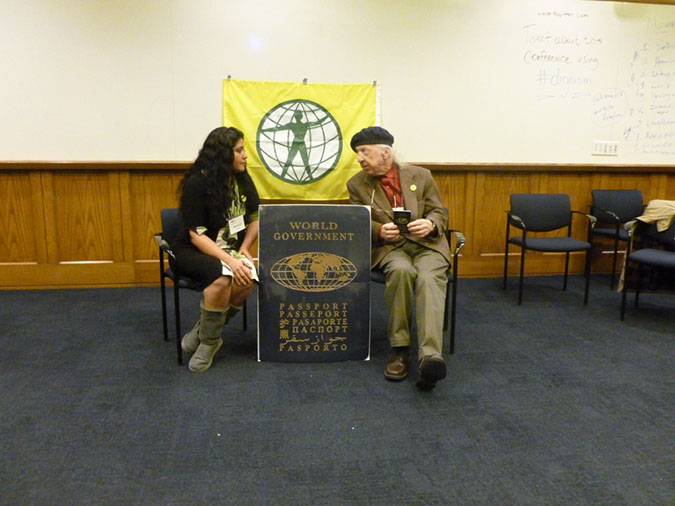
Please click on the picture above or here to see all the 177 photos of Day One of the 2012 Workshop
• Please see also The World Is My Country, and the documentary on Garry Davis by Arthur Kanegis:
Rosika Schwimmer and World Government
Rosika Schwimmer or Bédy-Schwimmer "Rózsa" Rózsika (1877-1948) set out to create a world government. In 1935 she formed the World Centre for Women's Archives with Mary Ritter Beard. She received a World Peace Prize in 1937 and formed the Campaign for World Government with Lola Maverick Lloyd. In 1947 she was nominated for Nobel Peace Prize but no one received it the next year...
Please read more on http://en.wikipedia.org/wiki/Rosika_Schwimmer, or, please read also Remarks on the History of Hungarian Feminism by Judit Acsády.
Creating an Inclusive Society: Practical Strategies to Promote Social Integration
Summary of E-dialogue, 23 May – 20 June 2007, organized by the Division for Social Policy and Development (DSPD) of the United Nations Department of Economic and Social Affairs (UNDESA), in collaboration with UNESCO and UN-HABITAT.
Please read more at http://www.un.org/esa/socdev.
UN 'Should Take Lead on Climate'
By Laura Trevelyan
BBC News, UN, New York
The top UN official on climate change says the failure of world leaders to agree on global warming means it is time for the UN to take the lead. Yvo de Boer, head of the UN Climate Secretariat, wants a summit of world leaders to talk about what happens when the Kyoto Protocol expires in 2012. Despite rising sea levels, there is no agreement on how to deal with global warming's long-term threat. In fact, Mr de Boer says, the process is getting more and more stuck...
Read the entire article at http://news.bbc.co.uk/go/pr/fr/-/1/hi/world/6269267.stm.
Richest 2% Own 'Half the Wealth'
By Andrew Walker
Economics correspondent, BBC World Service
The richest 2% of adults in the world own more than half of all household wealth, according to a new study by a United Nations research institute. The report, from the World Institute for Development Economics Research at the UN University, says that the poorer half of the world's population own barely 1% of global wealth. There have of course been many studies of worldwide inequality. But what is new about this report, the authors say, is its coverage.
It deals with all countries in the world - either actual data or estimates based on statistical analysis - and it deals with wealth, where most previous research has looked at income.
What they mean by wealth in this study is what people own, less what they owe - their debts. The assets include land, buildings, animals and financial assets.
Please read the entire article at http://news.bbc.co.uk/go/pr/fr/-/1/hi/business/6211250.stm.
UN Official to Push Burma Reform
UN official Ibrahim Gambari has arrived in Burma to press the military rulers to commit to democratic reforms.
During his four-day trip, he will meet military leader Than Shwe as well as opposition leader Aung San Suu Kyi, who is currently under house arrest.
The international community is piling pressure on Burma to make serious changes to its harsh regime.
But so far there has been been little indication that the ruling generals are willing to co-operate.
Mr Gambari last visited Burma in May, when he was given the rare opportunity of meeting Aung San Suu Kyi, the detained democracy leader who is seen as a symbol of resistance to Burma's ruling military junta.
It was the first time in more than two years that a foreigner had been allowed to meet her, and the visit fuelled hopes that she would soon be released, and that the military might finally make some concessions to international demands.
But almost as soon as Mr Gambari left the country, such hopes were dashed.
The government extended Aung San Suu Kyi's detention for another year, and continued to clamp down on her National League for Democracy Party (NLD) and other groups protesting against the regime.
A group of protesters were jailed only recently for compiling a petition against the government, to coincide with the re-opening of the country's national convention.
The convention, made up of delegates selected by the military junta from across the country, has been touted by the government as a forum in which to discuss Burma's future.
But the convention has been widely criticised as a tool for legitimising the military's hold on power, and the NLD has boycotted the proceedings.
Read the entire article at http://news.bbc.co.uk/go/pr/fr/-/2/hi/asia-pacific/6131202.stm.
The UN and the Principle of Sharing
by Mohammed Mesbahi.
Panel to Recommend Simplified UN
By Richard Black
Environment correspondent, BBC News website
The High-Level Panel on United Nations Reform will propose that the UN becomes a tighter and simpler body, according to a draft of the final report.
The panel says UN programmes are often "fragmented and weak", and it has too little power to enforce its plans in areas such as the environment.
The panel says agencies which reform should be rewarded with secure and sustained funding.
The report will be formally unveiled in New York on Thursday.
Convened by UN Secretary General Kofi Annan after last year's World Summit, the High-Level Panel of 15 people included such political luminaries as Pakistan's Prime Minister Shaukat Aziz, his Mozambique counterpart Luisa Diogo, and UK Chancellor of the Exchequer Gordon Brown.
They have spent six months preparing the report.
Please read the entire article at http://news.bbc.co.uk/go/pr/fr/-/1/hi/world/americas/6088200.stm.
UN Initiates Arms Trade Agreement
A United Nations committee has voted overwhelmingly to begin work on drawing up an international arms trade treaty. The measure would close loopholes in existing laws which mean guns still end up in conflict zones despite arms embargoes and export controls.
It could also stop the supply of weapons to countries whose development is being hampered by arms spending.
Only the US - a major arms manufacturer - voted against the treaty, saying it wanted to rely on existing agreements.
A total of 139 states voted for the motion. There were 24 abstentions.
Please read the entire article at http://news.bbc.co.uk/go/pr/fr/-/1/hi/world/americas/6088200.stm.
Global Alliance for Ministries and Departments of Peace
Under the name of the People's Initiative for Departments of Peace, the Global Alliance for Ministries and Departments of Peace was launched at the first People's Summit for Departments of Peace, held in London October 18-19, 2005, with the intention of supporting national-level campaigns to establish departments of peace in governments throughout the world. The following articles provide background information on the Global Alliance for Ministries and Departments of Peace.
The Pixel Press
At PixelPress our intent is to encourage documentary photographers, writers, filmmakers, artists, human rights workers and students to explore the world in ways that take advantage of the new possibilities provided by digital media. We seek a new paradigm of journalism, one that encourages an active dialogue between the author and reader and, also, the subject. Our online magazine features projects that use a variety of linear and non-linear strategies, attempting to articulate visions of human possibility even while confirming human frailty. For us the digital revolution is a revolution in consciousness, not in commerce. We work with organizations such as Crimes of War, Human Rights Watch, World Health Organization and UNICEF to create Web sites that deal directly with contemporary issues in complex and innovative ways that circumvent media sensationalism and simplification. We also try to factor in ways that the viewer can help remedy social problems, rather than remain a spectator. Recently we completed a site focusing on how to end polio worldwide; another trying to aid an orphanage in Rwanda; one trying to reclaim the Brazilian forest; and a site featuring the images of photographers from the Vietnam War. And we also create books with photographers such as Machiel Botman, Kent Klich and Sebastião Salgado on social themes, as well as traveling exhibitions using both digital and conventional processes.


 2003 – present, Human Dignity and Humiliation Studies